We all do it some or other time in our lives. Reading into a verse of the Bible, a meaning that does not exist in that verse at all. Of course, many times we do not mean to do it, but it happens because most of the time we are not well equipped to study the and interpret the Bible properly. On other occasions we come to the Bible rather maliciously, with a preconceived notion in our minds, looking for some verse to back up that notion. Any verse will do, really!
Such a misinterpretation happened just recently with regards to Is 9:6.
Isa 9:6-7 ESV "(6) For to us a child is born, to us a son is given; and the government shall be upon his shoulder, and his name shall be called Wonderful Counselor, Mighty God, Everlasting Father, Prince of Peace. (7) Of the increase of his government and of peace there will be no end, on the throne of David and over his kingdom, to establish it and to uphold it with justice and with righteousness from this time forth and forevermore. The zeal of the LORD of hosts will do this."
While giving his sermon/motivational speech, the preacher involved said, without referring to the Bible, "unto us a child is born, unto us a son is given, and the government shall be upon our shoulders." There was a deliberate misquotation of the verse quoted above. In the sermon he said that the first part of this prophecy has been fulfilled (unto us a child was born and unto us a son was given), the second part of this prophecy has not been fulfilled (the government shall be upon His shoulders) and the third part has been fulfilled (He shall be called Wonderful Counsellor...).
Continuing, he asked the question "Where was Jesus born? In heaven or on earth? Where was He called Wonderful Counsellor, etc? In heaven or on earth?" With each of these questions he clearly expected the people to say "on earth." Then he asked the final question: "Where will the government come upon His shoulders?" The natural answer from the audience was, "on earth." Then he went along explaining that Jesus is the head and the church is His body, therefore, the government spoken of in Is 9:6 will come upon the body of Christ, the church.
From this he concluded that South Africa needs a Christian government now, since the government is upon the shoulders of the body of Christ. I have no problem with Christian government and working towards that in any country, but to misinterpret this verse in that way is to do serious harm to the art of interpreting the Scriptures. This is clearly reading into this passage a meaning that was not intended by the writer of the passage, Isaiah!
The government spoken of in Is 9:6 has nothing to do with an earthly government in a country with boundaries around it. It has to do with the spiritual government of Christ over the Kingdom of God which has no earthly boundaries, but the hearts of men! To make this passage mean an earthly kingdom surrounded by physical boundaries is to grossly misinterpret this verse and to eventually make it meaningless!
When we take passages of Scripture and allowing ourselves to insert meanings into those passages that were not intended the original author, we effectively render those passages meaningless! It no longer bears the caption "Word of God" but rather "Man's Fantasy!"
It is this fantasy of man that leads to all kinds of doctrinal error and even heresy. It is incumbent upon us to guard against this by properly interpreting the Scriptures by letting the author speak without putting words in his mouth!
For those that like reading Adrian Warnock's blog probably have already discovered that his blog has a new URL. But, for those that did not know, his new URL is http://adrianwarnock.com/.
People have such a great misunderstanding of who God really is! While God nowhere promises us in the Scriptures that He will keep us from sinning, there are still people in the world who shifts blame away from themselves as the rightful heirs of their own responsibilities, to making God responsible for their own actions. A man in Romania is effectively suing God for breach of contract. Apparently, God broke His agreement with, Pavel Mircea, 40, which was made at Mircea's baptism. It seems that Mircea believes that God promised him at his baptism to protect him from all evil, but instead gave him over to Satan, who then made Mircea commit murder.
This is so clearly a case of implicit faith! James Montgomery Boice preached a sermon several years ago in which he gave this illustration on implicit faith. I can't remember all the details, but it goes something like this (or perhaps not at all!).
A man wanted to become a member of the church, and while he sat before the church board, he was asked what he believed. The man responded: "I believe what the church believes!" The board then asked: "What does the church believe?" The man then answered: "The church believes what I believe!" Finally the board asked him: "So, what do you and the church believe?" To which the man responded: "Oh, we believe the same thing!"
This is a very widespread norm amongst those who attend. Most people, like Mircea from Romania, simply implicitly believe what the church teaches on any subject, whether the church teaches the truth or not! For this man, and many in the church, there is just no idea that they need to study the Bible for themselves, to see if the church is indeed teaching faithfully from the word of God. This will lead to explicit faith.
Explicit faith is not based on the faith and teachings of another, but on a faith that was personally discovered through the study of the Bible. I am NOT saying that we should not listen to what the church has to say. What I am saying is that we need to take what the church says and study the relevant passages to confirm whether the church teaches faithfully on a given subject or not!
It would really be interesting to know how many people in the church believe what they believe because they have actually sat down and thought about their belief, and how many simply believe what they believe because it was uttered from the pulpit.
Christianity Today has an article called Gospel Riches.
Here is a snippet:
Pastor Michael Okonkwo rises from his gold-coated throne before 4,000 onlookers in Lagos, Nigeria. "Hallelujah!" bellows the self-proclaimed "father of fathers, pastor of pastors," wearing a glittery green gown. The crowd stands and roars.
A 62-year-old former banker and graduate of the Morris Cerullo School of Ministry in San Diego, California, Okonkwo touts a seminar called "Financial Intelligence"; if you've missed it, he encourages you to buy the tapes. Okonkwo describes the "intelligence" he preaches in his book Controlling Wealth God's Way: "[M]any are ignorant of the fact that God has already made provision for his children to be wealthy here on earth. When I say wealthy, I mean very, very rich. … Break loose! It is not a sin to desire to be wealthy."
I found it interesting that one of the Professors mentioned in this article, Allan H. Anderson, taught me Church History in South Africa.
With this edition of the series on Decision Making and the Will of God, we continue where we stopped last time. Our series ended with chapter 11 last time, and so we will pick up the thread with chapter 12 of Friesen's book, Decision Making and the Will of God.
This is part 7 of this series and we are only at chapter 12. The book has a total of 27 chapters and 3 appendices. So, as can be seen, this book has a great wealth of information on the subject at hand. Obviously, with all the exposure the subject gets, it is necessary to treat the subject fully. That is Friesen's with this book. Chapter 12 takes us into pretty foreign territory for the Western mind. That is, the sovereignty of God in His dealings with man. Friesen goes into the subject of God's sovereign will. Man is not the ultimate determiner of his own destiny. Neither is chance, or fate! God is the Ultimate Sovereign! And He has a will!
Friesen shows his readers what Scripture has revealed about God's will. 1. God's will is certain of being fulfilled; 2. God's will is detailed and includes all things; 3. God's will is hidden, except where expressly revealed; 4. God's will is supreme, yet, neither does it violate human responsibility, nor does it make God the author of sin; 5. God's will is perfect, leading to God being glorified and is for our good.
Friesen goes into detail with each of these points and really makes his case solid by use of Scripture. Even though we are not to be looking for that individual divine dot that shows us God's intended will for our individual lives, God is still in control and is guiding us divinely.
"[Ruth's] faith in God was rewarded when she entered Boaz's field, though she was unaware of God's sovereign guidance. There was no voice behind her saying, 'This is the field. Walk ye in it.' In fact the text says she 'happened to come' upon the field (Ruth 2:3)! Humanly speaking she had no specific reason for choosing the field, but God perfectly, secretly, in detail, guided her within His sovereign will."[1]
In essence, chapter 12 gives us the Biblical data on God's sovereign will. Chapter 13, on the other hand, is more specific and deals with planning, circumstances, fleeces and open doors.
If God is sovereignly in control, and His will is always fulfilled, then why should we bother planning? That is a question that many have asked. Friesen shows how the Bible expects us to plan. However, all our plans should be made in humility, understanding that our plans should be hedged by the little sentence, "if the Lord wills." We should plan in complete humility and with complete reliance on God.
The Traditional View normally uses circumstances as guiding markers in discerning God's individual will for our lives. However, Friesen makes it clear that Scripture never commands us to treat circumstances as any type of authority in discerning God's will about the future. Imagine a fire burning down a brothel. Many Christians will immediately say that it was God's judgement. Now, imagine a fire burning down an orphanage for HIV/AIDS orphans. Will Christians still call this God's judgement, or will it be the devil this time? You see, unless God reveals the reason for something, it will be pure presumption on our part to claim that we know what was behind it! That is why circumstances cannot be used for discerning our next steps.
If a door of opportunity is closed, would it be because God closed the door, or because the devil is trying to prevent the opportunity from being fruitful? Opportunity sometimes comes with an easy open door. At other times the door is wide open, but there is great resistance (1 Cor 16:8-9). At other times an open door may present itself, but need not be taken (2 Cor 2:12-13). Every open door cannot be seen as a command from God, but should rather be evaluated in wisdom.
The fact is, guidance throughout the Bible has always been a matter of miraculous revelation by God Himself, or by God's people using the wisdom God had already supplied. Inner impressions just do not tip the scale at all, and in fact do not feature in the Bible. It is either God initiating the guidance, or people using their God given wisdom supplied in God's revealed moral will.
"One of the temptations for us Reformed Charismatics is to just not talk about our experiences of the Spirit and the things we see. If we just don't talk about our charismatic experience it is much easier for us to fit in with our reformed brothers. At times I feel I am more interested in fitting in with my reformed brothers than my Arminian Charismatic brothers!"
Adrian nails it on the head concerning wanting to fit in with "our reformed brothers." My reasons for doing so may not be the same as Adrian's.
You see, I am a charismatic, but I am also very committed to the Reformed faith, more specifically New Covenant Theology. I was a committed Arminian for many years and defended Arminianism against these crazy Calvinists. However, God showed me the light back in 1998.
In my experience with Arminian Charismatics (ACs), theology is not a high priority. In fact, they are more led by their noses than the Scriptures so graciously given to us by God to be sufficient in faith and morals. To most ACs (and I chose "most" here carefully), Christianity is a life led by experiences and anecdotes. Even their "truth" is based on experience and anecdotes.
The last time I heard any exegetical justification from an AC for anything he believes or does, even from the pulpit, was ... um, aah, urgh! I can't think when that was!
ACs have no problem allowing Word-of-Faith preachers, modalists (read here, here, here, here and here), and the like in their fold because these guys are such dynamic preachers and they heal people! There are very few ACs that ever look at other preachers critically, especially if they are dynamic speakers. Being very funny from the pulpit will also give one great standing among ACs.
Are all ACs like this? I guess not! However, from my experience that would be the exception.
It is for the reasons above that I prefer to be "in" with our reformed brothers.
Updated: 19 June 2007 I bolded, italicized, and "redded" the words "my experience" in my post, since there are some brothers (sisters too?) out there that do not seem to have the ability to read clearly.
Due to the length of time that it has been taking to do this series on Decision Making and the Will of God, I have decided to combine more chapters at a time per post. My last post was on chapter 8 of the book.
Even though it is taking much longer to read this book than I had initially anticipated, I am enjoying what Friesen is saying in this volume very much. He is very balanced in his approach to the subject of "finding" the will of God. And, what I mean by being balanced, is that he only uses the Bible as the counterbalance on the other side of the scale. He constantly does exegesis of the relevant passages making sure that what he is proposing remains true to the Scriptures.
Many writers on this subject use page upon page of ditty little anecdotes to "prove" their point while hardly ever attempting to let the Bible speak for itself. Anecdotes prove nothing more than gullibility on the subject, since people have stories about just about anything in which they have "experienced" something to disprove our own "experiences."
Friesen continues to let the Bible speak on this issue, and I know that some out there will simply not like what Friesen has to say because of their own presuppositional biases.
Chapter 9 handles the subject of our God-given freedom and responsibility to choose. Friesen refers to Augustine who set forth a principle that says, "Where there is no command, God gives us freedom (and responsibility) to choose."[1] These are not Augustine's words, but this is what the principle comes down to.
Inside God's moral will, there is an area of freedom and responsibility. As a result, anything in which God did not pronounce a direct command or law, we have freedom and responsibility to choose the wise option. This freedom and responsibility as a unit is exemplified in God's command to Adam that he could eat from any tree of the garden except one. God gave a specific command concerning only one tree, from which Adam could not eat. Therefore, Adam could choose freely from any of the other trees without the need to be told which one to eat from next. This principle shows that within the given boundaries there is freedom.
After learning in chapter 9 about the freedom and responsibility to choose, we come to chapter 10 which answers the question, "On what basis does the believer make decisions?"
Whereas in chapter 9 we read that where there is no command, God gives us the freedom and responsibility to choose, we now find a further principle, "Where there is no command, God gives us wisdom to choose."[2] Friesen shows how men of God, in both the Old and New Testaments, had wisdom to make decisions in situations where God did not give direct revelation. Examples of verses in this regard are Eccl 10:10, Mt 10:16, Ac 15:28-29, 1 Cor 16:3-4 and 1 Thes 3:1.
Having built a case for the way of wisdom in chapter 10, drawing from the OT, Jesus and from the apostles, Friesen moves into chapter 11 looking more deeply at the lives of the apostles.
At the end of chapter 10, Friesen tells us that the real "clincher--the biblical data that provoked the radical reshaping of my understanding of decision making and the will of God--was the instruction of the apostles."[3]
Something that I have been battling with for some time now, way before I started reading Decision Making, is the idea that we should be seeking God's individual will for our lives on a daily basis, yet there are no examples, nor instruction to do so anywhere in the NT. Friesen picks up on this teaching and categorically states that it is not recorded even once, that the apostles ever tried to discover God's individual will for their lives. The apostles use phrases concerning their decision making that point to freedom in decision making.
I agree in this regard. We will be hard-pressed to prove from the NT that we are supposed to search for God's individual will for our daily lives.
As usual, Friesen builds principles in this regard: "In the area of freedom, the believer's goal is to make wise decisions on the basis of spiritual usefulness, Or, when there is no command, God gives freedom and wisdom to make spiritually advantageous decisions."[4 - Italics supplied by Friesen]
Naturally, Christians will ask how this wisdom is acquired. This involves the believer's attitude and approach.
A Christian's attitude must reflect the following: 1. Each Christian must become aware of the fact that no man is naturally wise, 2. He must have the conviction that God is the ultimate source of wisdom, 3. God will grant wisdom to those with certain characteristics, such as reverence for God, humility, teachableness, etc., 4. The believer must have faith.
In the proper approach, the believer must understand the following: 1. He must ask God for wisdom, 2. Wisdom is found in the Scriptures, 3. Outside research must be done where appropriate. 4. Wise counsellors are needed, 5. Life itself can provide wisdom, and 6. Direct revelation may sometimes be used by God himself to direct us. [This is dealt with in chapter 15 of Friesen's book.]
What Friesen is telling us here is that wisdom ultimately comes from God himself. The principle that where God has given us no commands, He gives us wisdom to choose is aimed at here. That wisdom can then be acquired through the right attitude and approach.
John Piper is very concerned about the spread of the "Prosperity Gospel" heresy. And, rightly so! When I walk through Christian bookstores, I see the sections on heresy growing at an alarming rate! Christian bookstore chains such as Impact, CUM, and Gospel Direct sell books by these heretics of the prosperity cult and others that by right should not be called Christians.
It is troubling that churches keep on supporting the sellers of and even sell these heresies themselves. I have posted extensively on this subject before in the series, Heresies in the Church.
John Piper, from Desiring God is also angry about these heretics that are given free reign. Watch this video to hear his words on this matter. This is probably the angriest I have heard in Piper's tone!
The Creation Museum finally opened its doors on 28 May 2007.
The Creation Museum presents a "walk through history." Designed by a former Universal Studios exhibit director, this state-of-the-art 60,000 square foot museum brings the pages of the Bible to life.

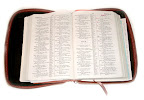 We all do it some or other time in our lives. Reading into a verse of the Bible, a meaning that does not exist in that verse at all. Of course, many times we do not mean to do it, but it happens because most of the time we are not well equipped to study the and interpret the Bible properly.
 While giving his sermon/motivational speech, the preacher involved said, without referring to the Bible, "unto us a child is born, unto us a son is given, and the government shall be upon our shoulders." There was a deliberate misquotation of the verse quoted above.