Friday, November 28, 2008

LIFECHAIN tomorrow!

This is a cross-post from my blog BiblioPolit.

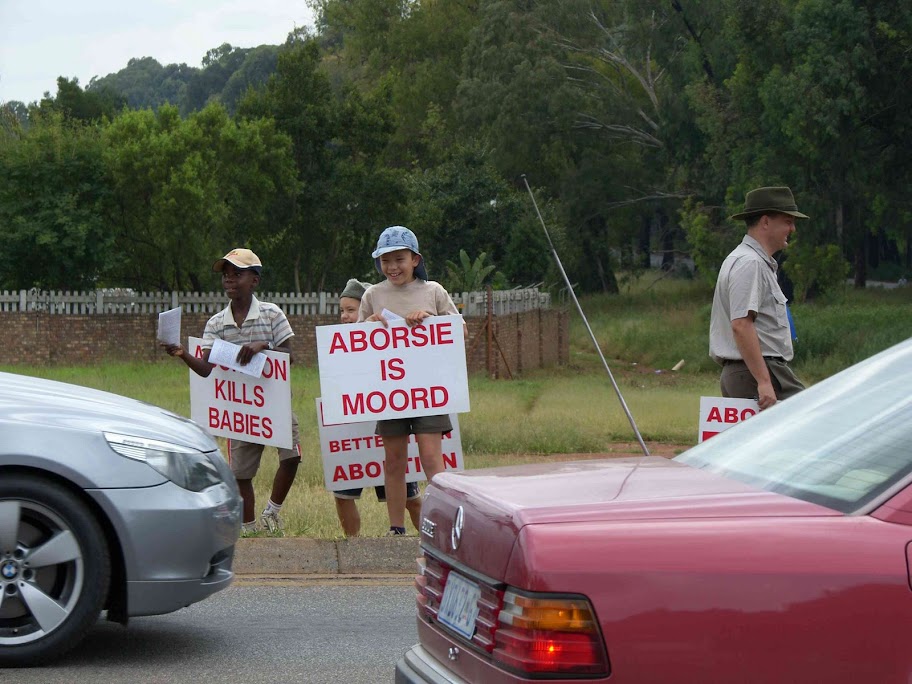
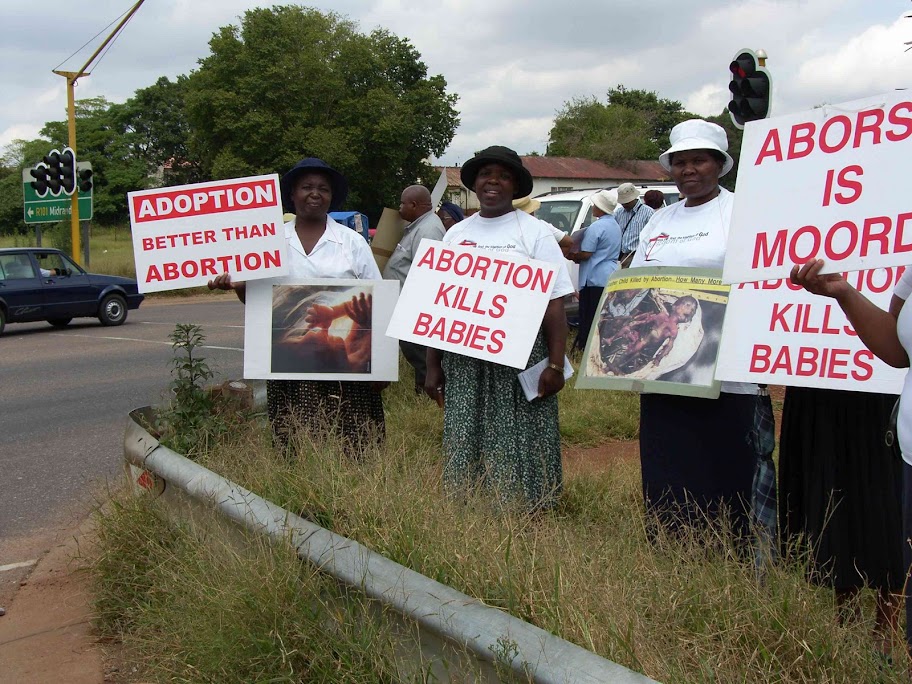
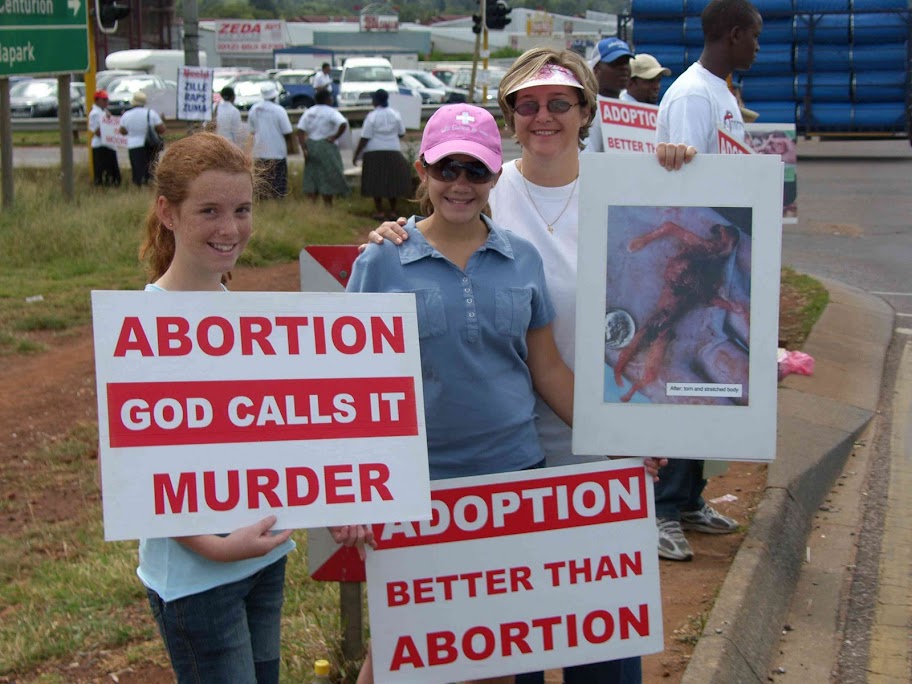
Back in March, 2008, we were part of a LIFECHAIN, to protest peaceably against abortion in South Africa.

Tomorrow we will be doing it again!

It will be on the corner of Hendrik Verwoerd and the Old Johannesburg Rd in Centurion (Pretoria, South Africa).

We will start at 09:00 until 12:00. See this map for directions. Everybody is welcome to join us and to hand out leaflets and protest peaceably with posters.

See some of the photographs below from our March 2008 LIFECHAIN.

You will notice that there were all kinds of people present!



NCT Friday: Introduction


Since I believe in the system called New Covenant Theology (as opposed to Covenant Theology and Dispensationalism), I have thought that it would be good to make something related to New Covenant Theology (NCT) available every Friday.

Today, as the first offering, I would like to point you to a short article which defines NCT.

"New Covenant Theology (NCT) describes how the unfolding plan of salvation in Scripture is to be understood. It focuses on the relationship between the Old and New Covenants. It views the nation of Israel as a picture of the people of God but not the believing people of God. It understands the Mosaic Covenant to be a legal covenant that demands perfect obedience in order to receive the promised blessings. It views the Ten Commandments as the essence of the Mosaic law and not the essence of all of God’s law. It views the New Covenant as a new and better covenant that replaces the Old Covenant. New Covenant Theology differs from both Covenant Theology and Dispensationalism."

To learn more, visit the links on the page edited by David White called NCT - Useful Free PDF's and Web Resources. What I am posting here is David's updated page from Facebook. The first edition can be found here. I had to remove the previous link to Geoff Volker and Mike Adams' article "Defining New Covenant Theology," since it is no longer available. If you know where I can get hold of that article, please let me know!

If you really want to learn about New Covenant Theology without becoming contentious, there are 2 very good NCT Facebook groups to join: New Covenant Grace, and Discover New Covenant Theology.

Update:
Next, NCT Friday: Common FAQ.

Wednesday, November 26, 2008

Read better!

Tim Challies, once again provides us with something worthwhile to read and make us better at something. He provides us with 10 tips to read more and better:
  1. Read
  2. Read Widely
  3. Read Deliberately
  4. Read Interactively
  5. Read with Discernment
  6. Read Heavy Books
  7. Read Light Books
  8. Read New Books
  9. Read Old Books
  10. Read What Your Heroes Read
To find out more on each point, read Tim's post, "10 Tips to Read More and Read Better."

Sunday, November 23, 2008

International Museum of the History of the Reformation

The International Museum of the History of the Reformation in Geneva is now open!

HT: Michael Dewalt

Is your child thinking of becomng a pastor?


What would these people have said if they saw Paul's ministry?

HT: Dan Phillips

Why our first parents were punished so severely

I have been reading the City of God by St. Augustine. I have to admit, for me it is not an easy read. It is an enjoyable book, but for me, it is going slow. Augustine was one of the great minds of his time, and this mind (i.e. my own) is no match for Augustine. I constantly have to keep my mind in overdrive. Yet, it remains enjoyable.

The book is available online at CCEL, in the same translation of the book in my hand. It can also be downloaded from the online page in PDF format, but then you need to be registered (for free) as a member.

Anyway, Augustine, concerning the reason for the harsh punishment on Adam and Eve for their sin, says the following:
"Therefore, because the sin was a despising of the authority of God,—who had created man; who had made him in His own image; who had set him above the other animals; who had placed him in Paradise; who had enriched him with abundance of every kind and of safety; who had laid upon him neither many, nor great, nor difficult commandments, but, in order to make a wholesome obedience easy to him, had given him a single very brief and very light precept by which He reminded that creature whose service was to be free that He was Lord,—it was just that condemnation followed, and condemnation such that man, who by keeping the commandments should have been spiritual even in his flesh, became fleshly even in his spirit; and as in his pride he had sought to be his own satisfaction, God in His justice abandoned him to himself, not to live in the absolute independence he affected, but instead of the liberty he desired, to live dissatisfied with himself in a hard and miserable bondage to him to whom by sinning he had yielded himself, doomed in spite of himself to die in body as he had willingly become dead in spirit, condemned even to eternal death (had not the grace of God delivered him) because he had forsaken eternal life. Whoever thinks such punishment either excessive or unjust shows his inability to measure the great iniquity of sinning where sin might so easily have been avoided." (Book XIV, 15)

I am not in complete agreement on this.

I can see why Augustine would say that the punishment was so severe. To Augustine, the severity of the punishment is the inverse of the ease with which God's command could have been kept, i.e. Because it should have been so incredibly easy for our first parents to refuse to eat from "the tree of the knowledge of good and evil" (Gen 2:17), God decided to punish them very harshly.

Augustine's idea doesn't necessarily follow, since I am not so sure that the Biblical data points this way. James in his NT book says the following:
"(10) For whoever keeps the whole law but fails in one point has become accountable for all of it. (11) For he who said, 'Do not commit adultery,' also said, 'Do not murder.' If you do not commit adultery but do murder, you have become a transgressor of the law." (Js 2:10-11)

According to James, it is not the level of difficulty in keeping the law that is important, but the One who gave the law. It is not even the individual commandment within the law, but the One who gave that commandment. James highlights the fact that the One who said 'Do not commit adultery,' is the same One who said, 'Do not murder.' So, it is the importance of the Lawgiver that should draw our attention, not the individual commandments of the law.

Granted, the first law only contained one commandment: "Don't eat from THAT tree!" However, the severity of the punishment on mankind, not just on our protoparents, has nothing to do with the ease of keeping the law, but with the Lawgiver Himself.

So, this gets us somewhere.

In October 2005, in a blog post I entitled "What is the Gospel? What is the foundation to the Gospel?," I wrote the following:
"God is an infinitely holy God, and His justice therefore demands infinite vindication before the righteousness of God. Without an infinite payment (which only Christ could fulfill), only an eternal payment by sinners could even begin to vindicate the holiness of God."

When we sin, no matter how "small" the sin, we are sinning against a holy God. Since God is infinite, we have to agree that His holiness is also infinite. Therefore, the punishment for sin against infinite holiness must be commensurate with the holiness that was infringed upon. Remember, sin is not merely the breaking of the law. It is disobedience against a infinitely holy God! Propitiation for sin against infinite holiness cannot be a simple slap on the wrist! That would be a gross misunderstanding of who God is!

So, the reason our protoparents, and through them us, were punished so severely, is that the payment for their sin had to be an infinite payment to satisfy the wrath of an infinitely holy God.

Thank God for sending Jesus, that He could be "the propitiation for our sins!" (1 Jn 4:10) Only an infinite sacrifice could satisfy infinite holiness!

Where can you buy The City of God?
Amazon US - $12.44
Amazon UK - £9.23
Kalahari.net RSA - R199.71
Christianbook.com - $12.99

Friday, November 14, 2008

The transformation of evangelicalism

Transformation is not always good. There are times when transformation is actually bad.

When the apostle Paul wrote in Rom 12:2 that we should "not be conformed to this world, but be transformed by the renewal of [our] mind[s]," he meant that our transformation should lead to become more like Christ. Yet, the transformation of evangelicalism is not towards becoming like Christ, but rather like the world.

Dan Phillips has written an interesting commentary on the recent American presidential elections, with some warning attached to the evangelical church:
"But all around, you find "evangelicals" enamored with trying as hard as they can to sell off their birthright to be more acceptable to the world — the kin of Tony Campolo and Brian Maclaren and Jim Wallis and the like.

"What we see, all too often, are professed Christians with an unclear, edgeless Gospel, little or no clue as to how to apply the Bible to life — but a burning desire to fit in with the Christ-hating world."

Read more...

Thursday, November 13, 2008

Forever young!

The world wants to be forever young. Unfortunately, it seems that the church is unashamedly on the same quest!

Carl Trueman wrote an excellent commentary on the forever-young syndrome:
"In some ways, today's world is the very antithesis of earlier ages. I always found sixteenth and seventeenth century paintings of children to be somewhat creepy: adult heads on tiny, immature bodies, as if the artists had no real concept of youth and childhood that allowed them to depict faces as such. Strange, isn't it, that the airbrushing techniques so often used in today's glossy magazines seem designed to have precisely the opposite effect: to place young heads on bodies that we know are much older. The concept of old age is perhaps slowly but surely being airbrushed out of representations in the popular media.

"Numerous incidents over recent years have brought the sad effect of all this home to me. As a professor at university and seminary, I have had too many run-ins with students who act like five year olds and, when held to account, express all the pouting resentment that one comes to expect from a generation that demands respect but refuses to put in the time and effort to earn it. You see them on the blogs, screaming their abuse and demanding to be heard, carrying on their tirades long after the threshold of Godwin's Law and any semblance of decency or credibility has been passed for the umpteenth time. They have achieved nothing - but they demand that you respect them!"

Read more...

HT: Frank Turk

Monday, November 03, 2008

Worldview Course: the Truth Project


I am planning to run a worldview course in the beginning of 2009, in Pretoria, South Africa. It is called the Truth Project, and it is a DVD-based worldview tour. My plan is to run the course from around the 2nd or 3rd week in January. It is a 13 week course, and the lessons can be seen at the bottom of this post.

This is probably the best I have seen on the subject of worldview, and I did attend a Truth Project leader’s training seminar in Johannesburg with the presenter of the series.

I am sure we all know the importance of a Biblical worldview, and while this course will take up some of your time, I can guarantee that it will definitely not be time wasted.

Further, because this is a DVD-based course, it will be held in my own house, or someone else’s house. Each lesson is +-1 hour long, and we will also have time to discuss what we heard in that lesson.

If you are interested, please let me know so that I can start planning. Please feel free
to pass this invitation to others whom you think may also want to attend a course like this around Pretoria.

The course is designed for around 12 people at a time, so first come first served.

Friday, October 31, 2008

Snappy quotes that show Biblical illiteracy

I was busy on Facebook, when I discovered the profile of someone I knew some time ago. In her profile I saw that her favourite book is The Shack (also see this review), and that her favourire quote is "Religion seeks to define an infinite God. By definition, it is doomed to failure."

Of course, quotes like these seem very spiritual and they have a sense of mysticism to them, in which the one who quotes it seems to say that God is greater than the boxes we try to put Him in.

Naturally this goes well with that age old saying: "Don't put God in a box!"

Now, what would happen if we discover that God was indeed in a box? Or, rather, God's revelation of Himself is the box within which He wants us to think of Him. Is God, in His person, His grandeur, His glory, His magnificence, His power, His ability, in a box? Never! How can the Infinite be cast within the finite?

Yet, this is not the issue, is it? People who quote or make quotes such as "
Religion seeks to define an infinite God. By definition, it is doomed to failure," want to create a sense of greatness about their incredible knowledge about God, that He is so big, that we could not possibly define Him. They want everybody to fall into that illusion that God cannot be defined, therefore, we should not even try!

The problem with this scenario, is that it is a non-Biblical idea. The fact is, God can be defined. He defined Himself in His self-revelation to mankind in the Bible! The fact that God revealed Himself to us, in itself should tell us how important God deemed the fact that He can be defined! However, we do not do the defining of God; He defined Himself in His revelation to us!

I know it is true that "religion" cannot define God, but quotes such as the above hardly ever mean what they say on the face of it! There is usually some assumed meaning that the "quoter" is trying to convey. That is usually the meaning that has no Biblical warrant.

While it is true that religion cannot define God, this quote has that hidden transmission that tries to convey the message that we should put our doctrines aside, because they could not possibly define this infinite God! Yet, the fact is that God revealed Himself in those doctrines we hold so dear.

The problem with quotes like these is that they appear to convey the truth. It catches a lot of people off guard, and because it seems to convey the truth, they accept the message of the quote as truth.

Where will this lead us? This is a one way street that eventually leads to heresy! Since God is not defined, there can be no doctrines that limit what we believe about Him. As a result, we end up no longer believing in God, but 'god.' It is no longer god worthy of a capital letter, since it becomes a creature of our own making! This is no longer the God that revealed Himself to us in the Bible, but an image of our own making that we have carved in our own minds. This, God Himself has prohibited in the 2nd commandment: "You shall not make for yourself a carved image, or any likeness of anything that is in heaven above, or that is in the earth beneath, or that is in the water under the earth. You shall not bow down to them or serve them, for I the LORD your God am a jealous God."
(Exo 20:4-5)

When we start making God in our own image (god), then we have an inferior god that is worthless. This is the kind of god that Elijah mocked the Baal worshippers about: "Cry aloud, for he is a god. Either he is musing, or he is relieving himself, or he is on a journey, or perhaps he is asleep and must be awakened."(1 Ki 18:27) That is the kind of god that is created by little quotes like those above.

That is the kind of god we end up with in books like The Shack. It is not the God revealed in the Bible, but a god made in the minds of men. This is a god that has no power or influence outside the mind of the believer. This is NOT the God of the Bible!

Tuesday, October 28, 2008

Boettner's Reformed Doctrine of Predestination

Almost 3 years ago I wrote a short post giving the heads up for Loraine Boettner's book, The Reformed Doctrine of Predestination.

If you do not know what the Reformed doctrine of predestination is all about, simply revisit that post!

The Cares of this Life: Trust in God


GOD'S UNSHAKABLE KINGDOM from Randy Rohde on Vimeo

Monday, October 27, 2008

Preacher's slip of the tongue

Every now and again a preacher gets tongue tied, and when that knot comes undone, he will have a slip of the tongue.


HT: Joanna @ Crazy Christian Clips

9Marks Nov/Dec eJournal is available!

The 9Marks eJournal for Nov/Dec 2008 is now available. This edition is all about counselling in the church. It is also available for download in PDF format.

Monday, October 20, 2008

Another review of The Shack

Stephen Yuille wrote a very good review on the The Shack. In his review he writes:
"Whenever I get a book, I immediately glance at the recommendations. To be honest, I’m looking for names like Don Carson, J. I. Packer, R. C. Sproul, Sinclair Ferguson, John Piper, etc. – not because I think these men are infallible, but because I trust their discernment. Well, I didn’t find any recommendations from these men, but I did find one from Kathie Lee Gifford. You may think it’s unfair of me to say this, but I offer it for what it’s worth: a recommendation from Kathie Lee Gifford doesn’t instill confidence – not in me, anyway!...

"Young is unrelenting in his attempt to humanize God. In so doing, he crosses a line. Where is the awe and reverence? Where is the appeal to think great thoughts of God? Where is God’s glory and majesty? Where is God’s holiness? All of these things are trivialized by Young’s depiction of God triune as Elousia, Jesus, and Sarayu."

Continue the review here.

HT: Tim Challies

Update:
Gerald Hiestand also wrote a good review of the book:
"There are two fundamental difficulties I have with Young's 'anti-power”' motif. First, Young's portrayal of God is out of step with much of the way God is portrayed in Scripture. It's difficult to square Young's pacifistic Trinitarian portrayal with the God of Genesis 6, the Christ of Revelation 19, and the Holy Spirit of Acts 5. And it’s at this point that Young's theodicy falls short. The Scripture doesn't allow us to distance God from violence and coercion. The deeper question of theodicy is not simply how a good God can allow death and destruction, but how a good God can cause death and destruction. Young's book assumes the happiness of humanity is the highest good. The Bible does not affirm this."

Continue reading here.
Related Posts Widget for Blogs by LinkWithin